Showing posts with label travel. Show all posts

Tuesday, July 24, 2012

A layered Transport Model

Traffic seems to be growing in the country, especially in the capital and suburbs. Increasing number of vehicles and roads that are unable to accommodate them are the main reasons. The inevitable factor of undisciplined drivers & pedestrians does exist too. But the lack of infrastructure stands out. There ought to be short-term and long-term policy brainstorming being performed somewhere out there, but with unseen results. So, I have visualised a transport model, if anyone's interested in taking my 'five cents'.

The best way is to study how some countries have successfully curbed traffic congestion. Once, I met a person who worked in Italy, and he was telling me that they had planned their cities a long time ago as a 'layered' plan. I don't know whether this is correct as a fact, but some evidence can be seen. What I propose is something on the same lines, because widening existing roads or building new ones aren't always feasible, given that we are a developing nation and rely highly on foreign monetary assistance. Not to mention the scarcity of available lands. Well, we do need financial assistance, but whatever infrastructure built needs to be sustainable or else we'll end up in a similar situation a few years down the line.

When the Dutch built a canal system in Colombo, it couldn't have been a part of a long-term plan, but may be because they thought of it as the most viable transportation system suitable for the geography of the area. After all this was an era with no fuel-driven vehicles. In my plan I propose these existing waterways be utilised for transport. A project was kicked-off two years ago, but hasn't lasted long. I think the publicity and popularity it received was not enough, for otherwise the system was a very low-cost transportation method. Mind you, safety and health matters need to be taken care of too. But these type of waterways are utilised immensely in developed countries.

The other issues are with roads and railroads. I propose a merge. How? There are two ways: subways under the existing roads or elevated railway lines over the existing roads. This provides for maximum utilisation of land and infrastructure since what we are talking is a 'vertical' approach as opposed to the orthodox 'horizontal' approach.


 A subway


 An overhead (elevated) railway

This of course has been implemented in many countries as seen in the pictures above. If all three layers (subway, highway, overhead) could be implemented in one alignment that would be an ultimate solution. I even propose that overhead railways or roads be built over existing waterways, thereby making use of them both. If the costs involved are deemed to be high, still it is much sustainable than our current solutions. My point is a layered approach and not necessarily everything what I've highlighted here. But if any decision-maker is willing to extract something of this that seems to be practical and feasible, be my guest.


The model - illustrated


Monday, April 19, 2010

The need to recreate

Wake up, morning chores, go to work, come back home, evening chores, dine and sleep seems to be the customary routine for many individuals these days. One could settle for this, given that we are machines and not ‘Homo sapiens’. But our origins have a great effect that guides our physical and mental intuitiveness although suppressed by the aforesaid lifestyle.


The consequences are not so lovely. From stress to Gastritis, Cholesterol to Diabetes, failed marriages to suicides, etc., a very lengthy list can be compiled. So what’s the solution? Back to the Stone Age? Or is there a compromise? In fact, there’s more than a compromise if one thinks of it as a necessity. We need to find a way to balance our way of life with these hectic routines. This is how the concept of recreation has come about.


As the term implies, it’s all about re-creating a ‘demolished’ or ‘damaged’ person. Recreation is mainly two-fold; physical and mental. But the trend and usage is more towards the physical aspect. This although shouldn’t be misinterpreted, because one’s physical vigour effects his/her state of mind and vice-versa. The physical approach is more popular and easily cultivated as it has always been throughout the history of mankind. For example, a layperson will often prefer listening to a meditative melody instead of actually meditating; even though the latter’s result is direct and much rewarding.


Recreational activities are multi-pronged which includes sports (individuals/teams), gym workouts, jogging, indoor/outdoor activities, and even less considered areas such as aesthetics, yoga, massage therapy, etc. The list is diverse and extensive. If you are into sports it could either be individualistic such as swimming or a team sport or both. While the former improves self-confidence greatly, the latter will enhance team skills. Moreover, some sports could be played indoors or outdoors as well (i.e. Carom, Table Tennis). Your choice of sport can be chosen depending on your schedule, available partners, access to equipment and facilities etc. For the loner who prefers minimalism a daily jogging session is ideal, if not he/she could always opt for a gym.


Another form of recreation is the outdoor activities such as travelling, hiking/mountaineering, boat riding, etc. These are extremely popular among westerners too. Some even go for extreme adventure such as bungee jumping or white-water rafting. Travelling in general is a hugely appreciated way of seeking the much looked-for difference in our everyday life, but should be combined with another since of its less frequency and the time needed. Currently, more and more people are in search of spiritual techniques for the easing and healing of conditions such as stress and anxiety. The popularity of Yoga is a result of this. It has the ability of affecting one’s physique and mental well-being.


There are numerous other ways of engaging yourself in recreational activity other than what’s stated here. An important thing that needs mentioning is, if you are new to any of this or planning to start on any, make sure to learn, train, or be accompanied by trained and experienced individuals since otherwise you could end up in a great mess.


The inevitable question most of us have is, ‘Ok, I see & know the importance. BUT how am I going to find time for this?’ I have a question as the answer for this. Do you want to live a healthy and satisfactory life? If the answer is yes, I’m sure you’ll find the time. It takes only a bit of will and skilful time management.

Wednesday, November 08, 2006

Discovering Kuruwita

Kuruwita is a moderate sized town situated just about 10 km before reaching Ratnapura, if you’re travelling from Colombo. ‘Kuru Ganga’, which is the main tributary of the ‘Kalu Ganga’, with its origins at the Adams peak (Sri-pada) flows through this town; hence its name.

Many people consider Kuruwita as a route to Sri-pada (through Eratna) during the pilgrimage season or for its close proximity to the beautiful ‘Bopath Ella’ falls. It was same even with me until about 1½ years ago when I started discovering what a ‘package’ Kuruwita offers to a visitor.

Batadomba lena cave, Diva guhawa, Delgamuwa temple, Bopath falls and Dodan falls could be identified as main attractions in and around Kuruwita while all these locations could be reached during a days visit.

Let’s start off at Batadombalena which became an important archeological site after evidence related to pre-historic human activities were discovered. To reach the location, you should turn off at Ekneligoda on the Kuruwita - Erathna road and travel along the Siripagama road for about 3 - 4 kms. Get off at the Batadomba-lena junction and climb the hill on the left, trekking through the forest path for about 1 km. It’s worth to note that Siripagama is another route for pilgrims during the Sripada season. Batadomba lena consists of a few caves including a main cave which excavation is carried out from time to time. A visitor may be lucky to witness a little shower of water falling in front of the cave from the top if it’s a wet season. The road through the forest to the cave is a wonderful experience itself since it runs along a stream for a considerable distance.


Next stop is Divaguhawa. Come back to Ekneligoda and continue towards Eratna until you reach the Batathota junction. Take the road to the left for about 1 mile to reach the location which is now a temple known as ‘Batatota len viharaya’. This cave is big and spacious with some ancient constructions & drawings dating back to the Kandyan era. People believe this to be the cave which the Buddha visited on his journey to Sri-pada, although many wouldn’t agree with it. Adam's peak is clearly visible to this cave and it attracts a huge number of devotees during the Sri-pada season. If you are keen enough you may descend a bit further down from this main cave to the ‘Isthripura’ caves as well.

Back to Kuruwita and head towards avissawella for about ½ km. Go down the road in front of the Kuruwita post office for about 1 km to reach the ‘Delgamuwa Raja Maha Viharaya’. This temple is situated on an elevated land in close proximity to the Kuru ganga. The temple is said to have enshrined the sacred tooth relic of the Buddha during the kandyan era. The tooth relic was hidden within a huge quern made out of rock. This quern is to be seen even today.

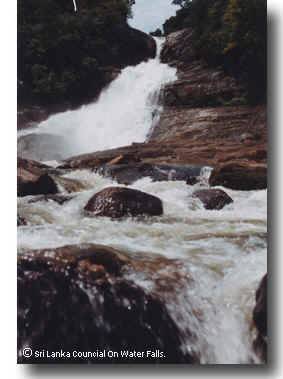
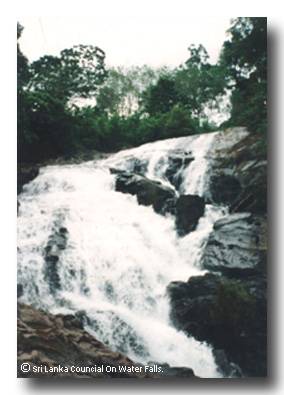
I then reached the Higgashena bazaar and turned right to reach my next destination, ‘Bopath Ella’ falls. ‘Bopath’ means ‘Bo’ leaf in Sinhalese, which gives the falls its name since it cascades forming a similar shape. This is by far the most popular tourist attraction around Kuruwita and attracts many visitors during the weekend. Special care should be taken when bathing here as many have drowned in the recent past.


One might find it worthwhile to travel for about another 2 kilometers from Bopath Ella towards the Devipahala area, where the much unknown ‘Dodan Ella’ falls is situated. The fall is created by a tributary of the Kuru ganga which joins it near Bopath Ella. The topmost part of the fall descends to a deep pool where the water isn’t spilled over, but instead emerges underneath the rock and continues to cascade through to the second stage. This indeed is a strange and rare formation. A visitor has to descend down the waterfall along its edge to reach the bottom of the falls since no other path is available. Again prompt care should be taken when descending or climbing back up. The vicinity of the falls isn’t spacious as Bopath Ella but one could have a nice cool bath if interested.


Kuruwita offers more scenic and interesting places to visit apart from what I’ve mentioned here. Once the tour has completed, it’s just a maximum 2 hour drive back if you’re a visitor from Colombo.


Note: It’s very important that visitors behave responsibly while not causing damage to the environment at these places of visit.


Image sources:
http://www.srilankanwaterfalls.net
http://www.frontlineonnet.com/fl2112/stories/20040618003109700.htm