Showing posts with label sri lanka. Show all posts

Monday, August 25, 2014

“No Fly Zone”

In general this hasn’t been a good year for the field of aviation. Starting from Flight 370, then Flight 17, then a couple of crashes in Brazil and Iraq, it’s been bad news one after the other. Causes of the afore-mentioned tragedies vary, with the exception of “MH370” which basically disappeared. Hence it’s rather coincidental that I came to hear an aviation-related mobile announcement in my neighborhood of Boralesgamuwa a fortnight ago. A van was airing a notice which gave a meaning similar to the following:

“We request you to avoid flying any kites in this area as it may cause a threat to aircrafts and passengers onboard.”

A fair enough request, given that the Ratmalana Airport is only about 2km away. But this was the first time I heard such a statement from the authorities. So I did some searching to see if kites are that hazardous as portrayed. And was surprised with the first article I stumbled upon. Apparently a nylon thread seemed to be the cause of a helicopter crash in the Philippines which killed two crew members and seven people on the ground! An important piece of information in that article is regarding the regulations and distance prohibiting kite-flying. I wondered if there were similar regulations in our country as well. Therefore I phoned the airport and inquired. According to the officer who answered me, there were no such specific laws or regulations which prohibited the leisure-time activity, but they will request the relevant local police stations to take action to clear the “sky paths” if needed. When I inquired of the height and distance from the airport that might be acceptable to fly a kite, he didn’t give any numbers. But explained to me how aeroplanes and low-flying helicopters encounter difficulties while approaching or departing the airport. August being the kite-season was a reason for the announcement to go out.

Further searching on regulations, I came across a couple: Hong Kong and the US. Notice the height/distance factors which are clearly mentioned and also the word “balloon” in the FAA page. The ATC of Netherlands has a more detailed page with maps highlighting prohibited areas in different colors along with a descriptive legend. May be our local authorities also should improve on this aspect. Enact regulations if there aren’t any and publish them on the official websites.

Still whatever the law may be, we as responsible and thoughtful citizens need to think of this stuff pretty seriously. And if you or your child needs to fly a kite, Galle Face Green is always there.☺

Thursday, November 01, 2012

Witnessing a Radio frequency migration


All FM radio channels in Sri Lanka underwent a frequency migration from November 1st 2012. Bear in mind, few channels were lucky to retain their previous frequencies. The reason is to have only one frequency (maximum two) for any channel throughout the island. According to the TRC, the policy of new frequency allocation in short is: ‘every channel receives a maximum of two frequencies separated by 200 kHz, and every channel is separated from another by 300 kHz’. Although practically there were a few exceptions, given factors like ownership of multiple channels, etc., this was the base. One downside I observed was that the entire 87.5 – 108 MHz range has now been allocated and sneaking-in new channels will be a tricky scenario, unless we adopt/implement a new technology.

So, I kept awake till the dawn of November 1st in order to witness how radio channels will handle this occasion. By 11.30 p.m. (October 31st) most channels were ‘out’ in the sense that either nothing or a long continuous irritating noise was heard. Some channels were promoting their would-be new frequencies. These ads were even seen on TV stations owned by the same media companies. A few had already migrated (e.g. Yes FM). The guys at FM Derana had a mini countdown to midnight and the frequency swapped at sharp 0000 Hrs. When I re-tuned, they were celebrating the migration with auspicious activities. Some channels were still blank and they were back live (obviously) in the morning. As I remember, a couple of channels were having parallel broadcasts before midnight while later switching to the new frequency only. It seems there was no uniform migration plan, but may be ‘overlapping’ channels decided on informal strategies within them.

On a final note, I think this should have happened long ago, but better late than never. It was also fun to experience such a (hopefully) rare occurrence.

Tuesday, July 24, 2012

A layered Transport Model

Traffic seems to be growing in the country, especially in the capital and suburbs. Increasing number of vehicles and roads that are unable to accommodate them are the main reasons. The inevitable factor of undisciplined drivers & pedestrians does exist too. But the lack of infrastructure stands out. There ought to be short-term and long-term policy brainstorming being performed somewhere out there, but with unseen results. So, I have visualised a transport model, if anyone's interested in taking my 'five cents'.

The best way is to study how some countries have successfully curbed traffic congestion. Once, I met a person who worked in Italy, and he was telling me that they had planned their cities a long time ago as a 'layered' plan. I don't know whether this is correct as a fact, but some evidence can be seen. What I propose is something on the same lines, because widening existing roads or building new ones aren't always feasible, given that we are a developing nation and rely highly on foreign monetary assistance. Not to mention the scarcity of available lands. Well, we do need financial assistance, but whatever infrastructure built needs to be sustainable or else we'll end up in a similar situation a few years down the line.

When the Dutch built a canal system in Colombo, it couldn't have been a part of a long-term plan, but may be because they thought of it as the most viable transportation system suitable for the geography of the area. After all this was an era with no fuel-driven vehicles. In my plan I propose these existing waterways be utilised for transport. A project was kicked-off two years ago, but hasn't lasted long. I think the publicity and popularity it received was not enough, for otherwise the system was a very low-cost transportation method. Mind you, safety and health matters need to be taken care of too. But these type of waterways are utilised immensely in developed countries.

The other issues are with roads and railroads. I propose a merge. How? There are two ways: subways under the existing roads or elevated railway lines over the existing roads. This provides for maximum utilisation of land and infrastructure since what we are talking is a 'vertical' approach as opposed to the orthodox 'horizontal' approach.


 A subway


 An overhead (elevated) railway

This of course has been implemented in many countries as seen in the pictures above. If all three layers (subway, highway, overhead) could be implemented in one alignment that would be an ultimate solution. I even propose that overhead railways or roads be built over existing waterways, thereby making use of them both. If the costs involved are deemed to be high, still it is much sustainable than our current solutions. My point is a layered approach and not necessarily everything what I've highlighted here. But if any decision-maker is willing to extract something of this that seems to be practical and feasible, be my guest.


The model - illustrated


Thursday, May 10, 2012

Sri Lankan 'rebel' players' tour to South Africa (1982) (a quick recap)

It was 18 years ago on a day like today that Nelson Mandela was sworn in as South Africa's first democratically elected black president, thereby officially ending the apartheid. During the apartheid, South Africa was banned from international sport and any team or players who travelled to play in that country were severely penalized, often with long durations of bans.

Towards the end of 1982, 14 Sri Lankan cricketers (some of them national players) made a 'rebel' tour to South Africa. The result was a 25 year ban to each of them. But, the most damaging impact was that our cricket-crazy island nation lost some of the most talented Sri Lankan cricketers and their services for the future. Hence, some experts believe that it would have retracted the country's cricketing prowess by a few good years.

Stats and records of the above-mentioned 'Arosa SL' tour are very scarce. But Cricinfo has a somewhat comprehensive (if one may regard it as such) record in their archives. I happened to stumble upon it and found the figures and scorecards pretty interesting. Although 12 matches were played, the archives have the scores of only 11 matches. The scorecard of an ODI is missing. Sri Lanka lost all matches with the exception of two, which were drawn against Western Province & Eastern Province teams. The tour comprised of four ODIs, six First-class matches & two 'Test' matches. Even though the Lankan players were beaten well and truly, there were some exceptional & consistent performances from a few of our talented players of yesteryear.

In order to discover these 'jewels' of both teams, and to obtain a hitherto unknown and a more relevant picture of these unseen (by me) players, I performed a very simple analysis noting down the best performances of players from the two teams. What I found have been listed below (format-wise).


First-class matches

For Sri Lanka, the most consistent batsmen were Bernard Perera & Anura Ranasinghe, both scoring more than 300 runs throughout the series. The highest score by a Lankan batsman was 96 by Perera. Bandula De Silva & Flavian Aponso too had made decent contributions. The standout bowler was Tony Opatha, while Ranasinghe & Lalith Kaluperuma had chipped in with a few wickets. Ranasinghe's all-round capabilities had left a prominent mark throughout these matches. I was also amazed to find out that Jerry Woutersz was a pretty good batter.

One thing I noted was that a few South African national players represented the Western Province team, including Peter Kirsten. There were altogether five centuries - two from Transvaal players (Mark Venter & Henry Fotheringham), another couple from Western Province players (Ken McEwan & Lawrence Seeff) and one from an Eastern Province batsman (Dave Richardson) - the highest being 159 runs made by Fotheringham. Bowlers such as Pienaar Anker, Kenny Watson, Kenneth Cooper & Michael Clare seemed to have had good spells capturing more than 5 wickets in matches they played.

Test matches

Though only two matches were played, six SL batsmen were able to score half centuries, while Bernard Perera was the sole centurion (102). Flavian Aponso and Jerry Woutersz were the most consistent batsmen. There is nothing much to talk about the Sri Lankan bowling in test matches, but Lalith Kaluperuma had managed to secure a 5-wicket haul.

While it wouldn't take rocket science to understand that the SA batsmen would have had a run feast, three of them stood out. Namely, Jimmy Cook, Graeme Pollock & Lawrence Seeff. All three of them had scored a 150+ score, the highest being a 197 by Pollock. Garth Le Roux's performance was the best for a SA bowler which included a 6-wicket haul as well.

ODI matches

The only Lankan batsman to score a century is Anura Ranasinghe (100). None of the others were able to surpass the half-century mark. This may sound a bit startling, given that each innings was played for 55 overs unlike nowadays. But then again, that might be attributed to good South African bowling. Bowling-wise too there isn't much to talk, except that Susantha Karunaratne had picked up a couple of wickets twice.

For South Africa, three batsmen made centuries: Jimmy Cook, Peter Kirsten & Lawrence Seeff; Seeff and Cook displaying their capabilities in the shorter format too. Barry Richards was also consistent making a couple of half centuries. Vince van der Bijl was the best bowler for the South Africans.


So that brings to an end my short recap/analysis of a long-forgotten and (in)famous series of the past. If you are interested in going through the scores and figures of each match, you may do so by visiting the link provided at the beginning of this article.

Saturday, July 23, 2011

Some special freshwater fishes of Sri Lanka

My interest on fish started at a very young age. Initially it was a few Guppies borrowed from a friend in school and which I kept in a huge toffee bottle. But then, to a bigger fish tank and another. Joining YZA was the climax of this. There, I was able to scientifically learn & study about all the freshwater fish species in Sri Lanka.

In this aspect too, our country is a blessed region, since we are very rich and diverse in fauna & flora. Sri Lanka is currently home to 80 odd indigenous freshwater fish species. (I'm a bit confused on the exact figure due to a few rapid changes and additions that have recently taken place in this sphere). Most people are startled to hear this fact and are also utterly unaware of the array of species our country possesses. Hence, on the positive, awareness through whichever means would benefit the conservation of our fauna & flora for generations to come. On these lines, I thought of sharing some acquired knowledge of freshwater fishes of Sri Lanka with you. And as it's difficult to provide information on each and every fish, I've chosen a few special species - although there are more - for this blog post.


1. Hora dandiya - Rasboroides atukorali - හොර දණ්ඩියා


I'll start from the two extremes. Previously known as Horadandia atukorali, this little fellow is the smallest freshwater fish in Sri Lanka growing to an average length of 2 cm or less. It belongs to the Cyprinidae family which accounts to the most number of species in the country. This fish has no lateral line and is transparent in colour with a light green hue. They often live in large schools close to the surface while feeding on planktons. It is a somewhat weak fish compared to other Cyprinids. Has been reported from the wet zone (locations such as Diyawanna Oya, Attidiya, Matugama) and Yala in the dry zone. Not an endemic species.


2. Shark catfish - Wallago attu - වලයා

A Walaya caught at Kitulgala - from Rohan Pethiyagoda's 'Freshwater fishes of Sri Lanka'


From the smallest now it's to the biggest. The Wallago is the largest freshwater fish in the country which measures to a maximum length of 5 feet, although individuals of this magnitude are very rare. Since its rarity in recent times, the Wildlife Conservation Society of Galle had once requested to report any sightings of the fish as part of a survey carried out by them. This species belongs to the Siluridae family which boasts of many large individuals.

The Shark catfish is blackish brown in colour and white underneath. It has two pairs of barbels out of which the maxillary is very long. The mouth which extends beyond the eye, suits its nature of being a voracious carnivore. Mostly active at night, its diet includes small fish, reptiles, birds and even mammals! This is a solitary creature that lives in deep pits in large rivers or tanks. It has been mainly reported from areas such as Kitulgala, Mahaweli River and tanks in the dry zone. Harmful means of fishing such as dynamiting is believed to have contributed towards the diminished numbers of this species and resulted in being extinct from some of the previously inhabited locations. It is not endemic to Sri Lanka and is also recorded from India.

Now I move onto a couple of fishes with unusual habits.


3. Archer fish - Toxotes chatareus - දුමිත්තා

     An Archerfish shoots at a target

Ever heard of a fish that spits? Well, this one certainly can. In fact, that's a way it hunts for food. And as its name implies this fish is a skilled shooter, which channels a jet of water towards a target over the surface thereby hitting the pray and causing it to fall. The younger ones are not very accurate, but they eventually develop and learn to deal with the angles concerning the refraction from air to water. This species is an average sized fish and shows a distribution from India to Northern Australia. It is found in both fresh and brackish waters and often in lagoons too.


4. Upside down sleeper - Butis butis - නිදිමතයා

     Laying upside down


Although called a 'sleeper', it's just a position that this species is sometimes found lazing around, not that they actually sleep (even its Sinhala name presents the same meaning). They are often found lying in one place on a surface. Due to this weird behaviour, it's sometimes even referred to as 'crazy fish'. This species belongs to the Eleotridae family which has another individual - Eleotris fusca - in Sri Lanka. It is carnivorous and feeds on smaller fish or crustaceans. Lives in fresh and brackish water while commonly found in lagoons, estuaries, swamps and lower reaches of freshwater streams.

The last two I've chosen are a bit unusual in appearance.


5. Freshwater garfish - Xenentodon cancila - යොන්නා


The Freshwater garfish is a 'needle fish' - because of its shape - and belongs to the Belonidae family. It grows to a maximum length of one foot although most reported are about 8 inches. Has big eyes and long jaws, and teeth of the bottom jaw protrude out while the upper ones don't. Length of its head is almost half the total body length. A dark band with a margin runs along the side of its body. They prefer to stay in one place, close to the surface in wide streams or large rivers. It's not the best-known swimmer and usually are found in packs of 7 or more. As a carnivorous individual, it feeds mostly on small fish & frogs, tadpoles or crustaceans and hunts mostly at night. The Garfish has been reported from areas such as Waga and Kithulgala while I once observed it in a tributary of the Magal Ganga at Deraniyagala. It's at times mistaken for the 'Halfbeak' known as මොරැල්ලා in Sinhala.


6. Ocellated pipefish - Microphis ocellatus - නැට්ටා


This fish belongs to the family Syngnathidae which includes Sea Horses too; the major difference being that sea horses hang about vertically (yes, they are fish. Not horses, or for that matter mammals!). These fish have a series of bony rings that encloses their body and have no scales. They feed by sucking into a tubular snout. Males have a brood pouch in which the eggs are laid, fertilized and incubated. It grows to a maximum 6 - 7 inches in length and is a VERY slow swimmer. It's also a very rare species and has been recorded only from a few locations in the wet zone. (e.g.: Avissawella, Agalawatta). Mainly occupies slow flowing habitats although may exist in fast flowing locales as well.


Tuesday, January 18, 2011

Who are the 'Isurumuni Lovers'?

Isurumuni LoversAccording to folklore Namalpura near Vijithapura during 455 - 473 A.D. (the reign of King Dhatusena) was ruled by a commander named Namal. This commander was executed by King Kashyapa due to his allegiance towards King Dhatusena and his elder son Mugalan. Commander Namal's only son, who was also known as Namal, was spared by Kashyapa. Young Namal's mother too passed away grieving over her husband's death. Hence, the young prince lost both his parents.


Prince Namal was a charming, talented and strong young man. His life was majorly devoted towards agriculture and religious activities.


One Vesak full moon poya day, this prince was attending religious activities at the Vijithapura monastery. Suddenly he couldn't believe his eyes with what he saw. She was the most beautiful damsel he had seen and he would ever see. He couldn't take his eyes of her, and so was she. They both grew close and talked with each other. While this conversation was going on the prince realized that the girl had heard about him and was longing to meet him. She was Chithra, a granddaughter of King Dhatusena. King Dhatusena had a brother named Kumarasena. Kumarasena had a son named Guptasena. Chithra was his daughter. She had a brother named Bandusena, who was a commander of King Kashyapa. Prince Namal knew Guptasena quite well.


Because of this friendship Prince Namal was invited the next day to Chithra's palace in the vicinity of 'Kala Wewa'. Chithra's parents gave Namal a warm welcome and their marriage was confirmed. The wedding had to be delayed since Chithra's brother Bandusena was abroad at that time. He was spying on Mugalan who escaped to India, according to the orders given by King Kashyapa. So it was decided that the wedding would be held once he returns back home.


During this time Namal and Chithra used to meet every evening and go for a walk. It was a well known fact to everyone in the area that the couple was engaged.


Meanwhile commander Bandusena returned back home from duty with a friend of his, named Mahanaga. Mahanaga was a deputy of Bandusena. Seeing Chithra, he told his friend Bandusena of his intentions of marrying her. Replying to him Bandusena said he may marry Chithra with her consent. Though this wasn't the time for Mahanaga to ask Chithra, he had high hopes that he'll be married to her.


Few days later Bandusena and Mahanaga were coming back from the palace when Mahanaga couldn't believe what he saw. It was prince Namal and princess Chithra seated on the bank of 'Kala Wewa' chatting with each other in a world of their own. Mahanaga couldn't bear it and his jealousy ended up in verbal abuse towards prince Namal. Being the calm character he is Namal wasn't intimidated. In fact he explained to Mahanaga and Bandusena about his relationship with Chithra and that he got her parents approval.


According to Bandusena's response it seemed as if he was totally unaware about the whole situation, because he was on a busy schedule since returning from India. But Mahanaga didn't want to give in, and it was decided that both of them resolute this matter with a 'Duel' (sword fight) between them. This was much to the comfort of Bandusena who didn't seem to have a solution. Though Mahanaga was in no position of denying the challenge, he insisted that someone like Namal was no match for him. Anyway according to the guidance of Bandusena, a venue and time was scheduled for the fight.


As expected the fight began amidst a huge gathering. Facing the first swing of sword from Namal, Mahanaga quickly learned that he had underestimated his opponent. It took another couple of swings for Namal to disarm Mahanaga. The third not only disarmed him but also ended his life. Namal emerged victorious!


Hearing about prince Namal's feat, King Kashyapa appointed him as a commander in chief. Prince Namal and Princess Chithra were married amidst celebrations. But their marriage wasn't to be a long lasting one.


A few months after their wedding came the rainy season. 'Kala wewa' was overflowing due to the heavy rains. And many people gathered towards the lake to watch this scenery. Among them were Namal and Chithra as well. When Chithra was approaching the left canal of 'Kala Wewa', in came a gust of wind and she was thrown in to the gushing water. Namal who jumped in to the water was able to save her life initially but the currents were too strong even for him, and they both were washed away and drowned. Their bodies were found lately and the funeral was held with state honour.


By this time, King Kashyapa had commenced renovation work at 'Isurumuniya'. It was done under the supervision of Kashyapa's elder daughter, princess Bodhi. She was also an expert architect. It is said and believed that the carving of the 'Isurumuni Lovers' was done by herself in remembrance of prince Namal and princess Chithra.


* This is a translation of an original Sinhala article published in the 'Divaina' newspaper of 04-09-2005. Its online version can be reached at: http://www.divaina.com/2005/09/04/scholast01.html

Wednesday, November 08, 2006

Discovering Kuruwita

Kuruwita is a moderate sized town situated just about 10 km before reaching Ratnapura, if you’re travelling from Colombo. ‘Kuru Ganga’, which is the main tributary of the ‘Kalu Ganga’, with its origins at the Adams peak (Sri-pada) flows through this town; hence its name.

Many people consider Kuruwita as a route to Sri-pada (through Eratna) during the pilgrimage season or for its close proximity to the beautiful ‘Bopath Ella’ falls. It was same even with me until about 1½ years ago when I started discovering what a ‘package’ Kuruwita offers to a visitor.

Batadomba lena cave, Diva guhawa, Delgamuwa temple, Bopath falls and Dodan falls could be identified as main attractions in and around Kuruwita while all these locations could be reached during a days visit.

Let’s start off at Batadombalena which became an important archeological site after evidence related to pre-historic human activities were discovered. To reach the location, you should turn off at Ekneligoda on the Kuruwita - Erathna road and travel along the Siripagama road for about 3 - 4 kms. Get off at the Batadomba-lena junction and climb the hill on the left, trekking through the forest path for about 1 km. It’s worth to note that Siripagama is another route for pilgrims during the Sripada season. Batadomba lena consists of a few caves including a main cave which excavation is carried out from time to time. A visitor may be lucky to witness a little shower of water falling in front of the cave from the top if it’s a wet season. The road through the forest to the cave is a wonderful experience itself since it runs along a stream for a considerable distance.


Next stop is Divaguhawa. Come back to Ekneligoda and continue towards Eratna until you reach the Batathota junction. Take the road to the left for about 1 mile to reach the location which is now a temple known as ‘Batatota len viharaya’. This cave is big and spacious with some ancient constructions & drawings dating back to the Kandyan era. People believe this to be the cave which the Buddha visited on his journey to Sri-pada, although many wouldn’t agree with it. Adam's peak is clearly visible to this cave and it attracts a huge number of devotees during the Sri-pada season. If you are keen enough you may descend a bit further down from this main cave to the ‘Isthripura’ caves as well.

Back to Kuruwita and head towards avissawella for about ½ km. Go down the road in front of the Kuruwita post office for about 1 km to reach the ‘Delgamuwa Raja Maha Viharaya’. This temple is situated on an elevated land in close proximity to the Kuru ganga. The temple is said to have enshrined the sacred tooth relic of the Buddha during the kandyan era. The tooth relic was hidden within a huge quern made out of rock. This quern is to be seen even today.

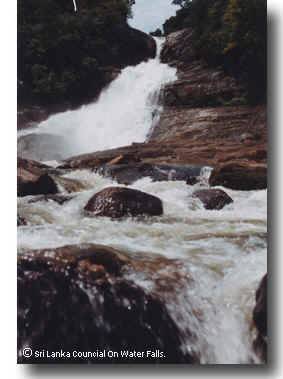
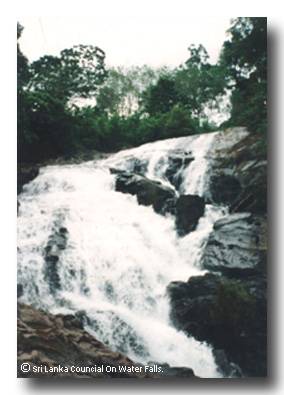
I then reached the Higgashena bazaar and turned right to reach my next destination, ‘Bopath Ella’ falls. ‘Bopath’ means ‘Bo’ leaf in Sinhalese, which gives the falls its name since it cascades forming a similar shape. This is by far the most popular tourist attraction around Kuruwita and attracts many visitors during the weekend. Special care should be taken when bathing here as many have drowned in the recent past.


One might find it worthwhile to travel for about another 2 kilometers from Bopath Ella towards the Devipahala area, where the much unknown ‘Dodan Ella’ falls is situated. The fall is created by a tributary of the Kuru ganga which joins it near Bopath Ella. The topmost part of the fall descends to a deep pool where the water isn’t spilled over, but instead emerges underneath the rock and continues to cascade through to the second stage. This indeed is a strange and rare formation. A visitor has to descend down the waterfall along its edge to reach the bottom of the falls since no other path is available. Again prompt care should be taken when descending or climbing back up. The vicinity of the falls isn’t spacious as Bopath Ella but one could have a nice cool bath if interested.


Kuruwita offers more scenic and interesting places to visit apart from what I’ve mentioned here. Once the tour has completed, it’s just a maximum 2 hour drive back if you’re a visitor from Colombo.


Note: It’s very important that visitors behave responsibly while not causing damage to the environment at these places of visit.


Image sources:
http://www.srilankanwaterfalls.net
http://www.frontlineonnet.com/fl2112/stories/20040618003109700.htm

Thursday, October 05, 2006

Mini Hydro Power Projects causing destruction!

While the controversy & stubborn decision making revolving around Upper Kothmale continues, there is a similar or much bigger yet unnoticeable issue developing within Sri Lanka’s Environment-for-Power policy.

True that we are a tropical country with a lot of rain, (not to mention the severe droughts that are on the increase) but does it justify our current practices of utilizing natural resources for the country’s so called never ending ‘Power Crisis’?

What is a ‘Mini Hydro Power Plant’ (MHPP)?
  1. It’s relatively small in size & the amount of electricity generated. (usually a few Megawatts or a few hundred Kilowatts)
  2. It users water to operate its turbines.
  3. The water is brought down to the powerhouse from a little reservoir built above it. A big & long tube or tunnel is used for this purpose.
  4. The little dam which stores the water is built across a stream or a small river. Hence, the flow of water is interrupted and re-routed through the tunnel or tube towards the turbines of the powerhouse.
  5. Sometimes there are exceptions such as, the turbine/generator being situated within the tunnel itself. (Figure 2)
(Figure 1)

(Figure 2)


As you see the little contribution that the MHPPs make are only sufficient to fulfill the power needs of a few houses or a small village. That’s why you would normally find several MHPPs built in close proximity in a ‘chosen’ area.

So, what are the attributes of a ‘chosen’ area? These areas should have a considerable rain fall throughout the year with streams flowing with a sufficient amount of water. This means that these areas are more often than not rich in biodiversity and scenic beauty. Districts like Kegalle, Ratnapura, the Central province and a few other districts that experience a heavy annual rain fall are more often the candidates.

A dam built across a river may not appear to have a great impact in a rainy season, but when the dry season with less or no rain fall arrives, (at the moment it’s 3-4 months per year) what happens is that the stretch of the river from the dam to the water outlet goes dry. (See Figure 3) This leads to a river or stream with no water for that specific range and directly affects species fauna & flora, water springs and waterfalls.

(Figure 3)


Our experience has shown that this sort of ecological change takes place shortly after a few days of no rain in some areas where MHPPs have been built.

The construction, operation and management of MHPPs are done in several ways. In Kitulgala, we came across MHPPs which were built with aid from the Asian Development Bank. The maintenance is done privately while the people in the area must contribute a monthly levy for the maintenance of the MHPP and to payoff the debt received from these international monetary organizations as aid.

There is a different scenario in the Maliboda area in Deraniyagala where private companies are responsible for the construction and maintenance of MHPPs. They in turn sell/add the generated power to the main national grid while the government pays them back. These companies have found a large profit already by setting up MHPPs and destroying the forest in the process.

Some of the forest areas destroyed belongs to strict natural reserves as well. This is mainly done when constructing the dam, tube/tunnel and the powerhouse. Many beautiful waterfalls in and around Deraniyagala have already been threatened due to this behavior. Parties responsible for setting up MHPPs receive their required approval and consent through corrupted government officials and politicians in the area. They also make use of the ‘thirst’ of electricity the people in these areas face, hence misleading them of the dangerous long-term effects to come.

Long-term effects:
  • Extended draughts.
  • Landslides due to de-forestation.
  • Extinction of rare/endemic fauna & flora.
  • Drying out of springs & waterfalls.
An example of dangers caused to the environment is currently visible in Nekkawita/Deraniyagala, where a 10 MW (Megawatts) powerhouse is being constructed. A tunnel with a length of more than 1.5 km is being dug and a canal being constructed. Huge loads of earth have been dumped in the river where a dam is being constructed, making the river’s water brown and muddy, threatening its species. One wonders whether the 10 MW is worth the destruction being done to the environment.

If the volume of water is reduced as a long-term effect, no need to say that the productivity of these MHPPs would be greatly hampered and questioned in the future, making them worth nothing after all that destruction done to the ecosystem.

Clearly visible is the loose stance the government is taking and at times even promoting these projects so that they could wash their hands off it. Instead the government should take suitable & necessary measures in monitoring and approving these constructions while finding alternatives of providing electricity to the people in these areas.

Hopefully this sort of article enlightens many people who weren’t aware of it. Because though most of us enjoy the scenic beauty in our country, it’s only a handful that is aware of the dangers we face in protecting our environment for the future generation.


Image sources:
http://www.builditsolar.com